Connection and safety in the beating heart of Maastricht
Wijkagent (district police officer) Patrick Sproncken and handhaver (local enforcement officer) Dennis Prevos do their best to ensure safety and quality of life in the Zuid-West (south west) and Centrum (city centre) districts in Maastricht. Their work is anything but boring: from events and tourism to engaging with youth and cracking down on organised crime – the centre in particular is an area of extremes. What binds them together? The human touch, cooperation, and visibility.
Report something immediately, don't wait until it gets out of hand. Online, using the MijnGemeente app, or just when we're in the neighborhood – we're always listening. Feel free to stop by the wijkbus - Patrick
Districts full of dynamism
Maastricht Zuid-West is a large area comprising the neighborhoods of Wolder, Biesland, Villapark, Campagne, Jekerdal, and Sint Pieter. The Centrum – Binnenstad, Boschstraatkwartier, Statenkwartier, Kommelkwartier, Jekerkwartier, Sint Maartenspoort, and Wyck – is a much smaller area than Zuid-West however it is highly dynamic and presents just as many, if not more challenges for the officers.
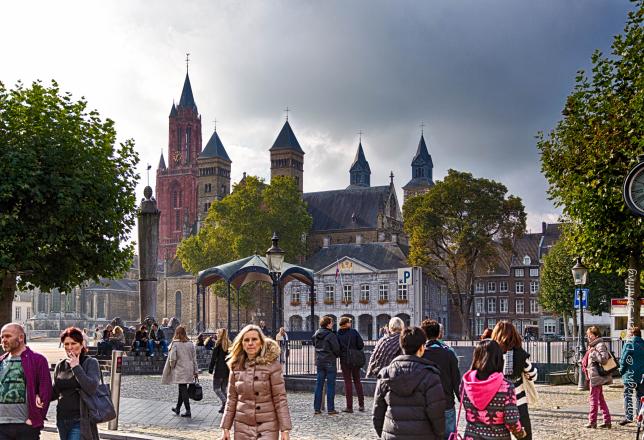
The Centrum has many faces. Shopping streets, restaurants, the train station: tens of thousands of people are on the move every day. “There's always something going on here,” says Dennis. “There are 30,000 residents in the area. On an average day, there are about 70,000 tourists. Add to that the big events such as André Rieu concerts, Koningsdag, and Magische Maastricht, during those times it's never quiet.”
Patrick adds: “In the city centre, for example, we come upon homeless people, addicts, vagrants, beggars. Shoplifting, pickpockets. There is also a lot of organised crime.”
They talked about how much time and work it takes to prove organised crime. The Gemeente (municipality) and the police work closely together on this.
Making contact: from wijkbus to TikTok
The district police officer and local enforcement officer are committed to maintaining contact with residents. This takes place in the streets, but also online. “As a district police officer, I am active on social media – X, Facebook, Instagram and TikTok, as well as the Centrummangement Maastricht app” says Patrick. Residents can report incidents online or by telephone to the police and also to Gemeente Maastricht using the MijnGemeente app, by telephone or in person at the Gemeente Loket (municipal service desk).
In-person contact is also important. For this purpose, for example, a wijkbus (district bus) is used as a police vehicle, and with this Patrick ensures there is an approachable police presence in the city centre. "We provide refreshments and lend a listening ear. When people can tell their story in person, a connection is created.”
“We don't just focus on visitors, but also on residents and entrepreneurs. Everyone has their own wishes and problems that need to be discussed with the police and enforcement agencies. The kinds of issues we discuss are parking and traffic problems, rubbish, noise and other irritations,” say the officers.
Working together on solution
The police and enforcement agencies work closely with partners such as Mondriaan (mental health care, prevention, addiction care and forensic psychiatry), Levanto (care and support for vulnerable people, Het Zorg- en Veiligheidshuis (care and safety home regional partnership), Halt (preventing and combating youth crime), jeugdboa’s (local enforcement officers for youth), woningstichtingen (housing associations) and Relim (services related to supported working and learning with the aim of developing people who are distanced from the labour market) in the city centre. Dennis: “We share information, coordinate and divide tasks. Sometimes the police take action, sometimes local enforcement. We always operate in consultation with each other.”
One example is the approach to organised crime, which recently led to the closure of a tanning salon after an investigation. “We also have Inrichting Stelselmatige Daders, ISD (institution for repeat offenders) programmes, in which repeat offenders receive 2 years of strict supervision with the aim of returning to society.”
Another common issue is people with misunderstood behaviour. They often end up at institutions such as Probe. Here, people are guided with support and supervision back into society.
Everyone is welcome to contribute their ideas. We're not just enforcers, we're also connectors. - Dennis
Young people, summer disruption, and perspective
Disruption from groups of younger people in the city centre increases in the summer months, especially in areas where young people have little to do. “We see young people hanging around with nothing to do, sometimes being annoying or intimidating,” says Patrick. “Noise, drug use, intimidation of local residents, it all happens. We talk to them, involve their parents, and work with youth officers to find solutions. But sometimes we also have to take enforcement action.”
Dennis adds: “A conversation can be the start of behavioural change. We must continue to seize those opportunities.”
What can residents do?
Dennis and Patrick want to encourage residents to continue reporting incidents. “Report something immediately, don't wait until it gets out of hand,” says Patrick. “Online, using the MijnGemeente app, or just when we're in the neighborhood – we're always listening. Feel free to stop by the wijkbus.”
Dennis adds: “Everyone is welcome to contribute their ideas. We're not just enforcers, we're also connectors.”
Would you like to contact the district police officer or local enforcement officer?
If you have a query or comment for the district police officer or local enforcement officer you can contact the police by going to politie.nl or by dialling 0900 8844. Contact Gemeente Maastricht’s local municipal enforcement team by dialling 14 043. You can report something using the MijnGemeente app or go to Report a problem or Iets melden (in Dutch) on the Gemeente Maastricht website.
Gemeente Maastricht have also recently launched an online reporting centre for street harassment. This includes all forms of unwanted attention in public spaces such as streets or parks. You can report this anonymously. By sharing your experience, you can help the municipality gather information which can be used to improve street lighting or to increase supervision in certain areas of the city.